
In many industrial sectors, used organic solvents are viewed simply as “waste”—a hazardous byproduct to be hauled away, incinerated, or disposed of at significant expense.
This conventional approach ignores the massive inherent value of the chemistry being discarded.
As an international sales and process explorer focused on operational excellence, I see this daily: manufacturers paying twice—first to buy the solvent, and second to get rid of it.
The emergence of Zeolite Membrane Pervaporation (PV) technology represents a fundamental shift from “Waste Management” to Strategic Asset Recovery.
By utilizing molecular sieving at the molecular level, manufacturers can transform a “waste” stream into a high-purity resource, reclaiming both the solvent and the capital previously lost to the linear disposal model.
The “Equipment for Free” Financial Reality
The financial logic of solvent recovery is driven by an industry-leading recovery yield of 99%.
To put this in perspective: if your facility is currently losing 100% of its solvent volume to waste, moving to a 99% reuse rate reduces your procurement needs by two orders of magnitude.
This isn’t just a marginal gain; it is a Total Cost of Ownership (TCO) revolution.
Whether your operation is a boutique lab or a massive industrial site, the technology is remarkably scalable, with processing capacities ranging from 50 TPY to 60,000 TPY.
The operating margins are equally compelling.
According to documented performance data, the operational cost for dehydrating Tetrahydrofuran (THF) is approximately $24.8 per ton, while Acetone can be processed for as little as $17.5 per ton.
Because the delta between these processing costs and the price of virgin solvents is so vast, the capital expenditure (CapEx) for a pervaporation unit is frequently offset in a very short window.
In most industrial applications, the procurement and disposal savings generated in a single year can cover the entire cost of the equipment.
Beyond Distillation: The Gas-Phase Advantage
Traditional distillation has a physical “ceiling”—the vapor-liquid equilibrium.
It fails when dealing with azeotropes or mixtures with near-identical boiling points.
Zeolite membranes break this barrier by operating on the principle of preferential adsorption within a gas-phase environment.
Unlike liquid-phase membranes, Greatwall’s technology vaporizes the solvent before it reaches the membrane.
In this gas state, molecules move at high speeds and in irregular patterns, which greatly improves the collision probability between water molecules and the membrane surface.
The zeolite layer, constructed with uniform “molecular sieve cages,” allows water molecules to quickly penetrate and diffuse while obstructing larger organic molecules.
“Not constrained by vapor-liquid equilibrium, it can separate challenging mixtures such as constant boiling point or near boiling point mixtures and isomers.”
The 75% Energy Discount
Energy consumption is the primary driver of high TCO in traditional separation.
Distillation requires the massive application of heat to move large volumes of material through phase changes.
In contrast, Greatwall’s PV technology offers an energy profile 50% to 75% lower than traditional methods.
This efficiency is the result of a highly targeted approach: the system is designed so that only the moisture permeates the membrane.
By moving significantly less mass through the separation barrier, the energy required for heating, condensation, and maintaining vacuum conditions is minimized.
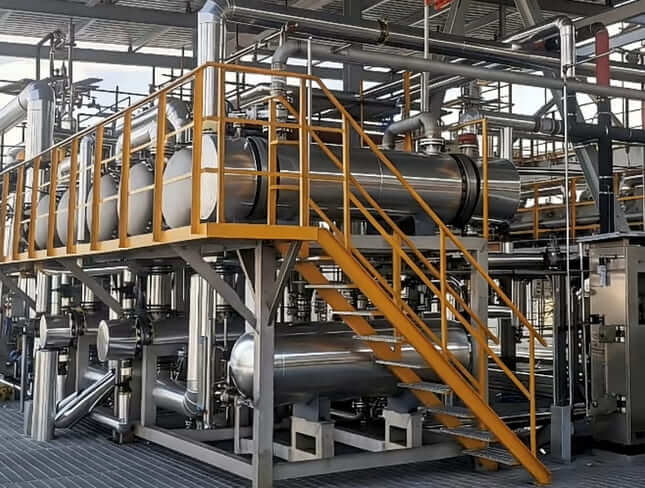
This compact, skid-mounted design allows for a 4/5 reduction in physical footprint, further lowering infrastructure investment.
Achieving “Ultra-Purity” and Compliance
The goal of asset recovery is to return the solvent to a state indistinguishable from—or superior to—virgin material.
Pervaporation delivers an unparalleled separation purity of 99.99%.
This technology doesn’t just save money; it ensures your facility meets the most stringent environmental benchmarks, including German TA Luft and ISO15848 standards.
Consider the dramatic moisture reduction capabilities across diverse solvents:
- Acetonitrile: Dehydration from 50% moisture down to 0.03%.
- Toluene: Dehydration from 1% moisture down to 0.01%.
- Isopropyl alcohol: Dehydration from 10% moisture down to 0.1%.
- Ethyl acetate: Dehydration from 15% moisture down to 0.5%.
- THF: Dehydration from 10% moisture down to 0.05%.
Protecting the Investment: The Golden Rules of Longevity
While a zeolite membrane has a service life of five years or more, this longevity is not guaranteed—it is earned through rigorous process control.
Ignoring the following operating parameters will result in irreversible flux reduction and premature CapEx replacement.
- Strict pH Governance: The feed material must stay within a pH range of 6.5 to 8.5. Acidic environments, in particular, will catastrophically shorten membrane life, destroying your investment in a matter of weeks.
- The “Enemies of Flux”: Pre-treatment is non-negotiable. Crystallizable salts (like calcium and magnesium) react deleteriously with the membrane, while viscous polymers adhere to the surface, gradually choking the processing capacity.
- Thermal and Moisture Thresholds: Feed moisture must not exceed 30%, and temperatures must be capped at 130 °C. Exceeding these limits leads to rapid thermal degradation and structural failure of the zeolite layer.
Conclusion: The Shift to Circularity
The transition from a “linear waste” model to a “circular process” is no longer a luxury—it is a requirement for competitive industrial operations.
By integrating zeolite membrane technology, you stop viewing solvents as an expense and start managing them as a strategic asset.
Is your current waste management strategy optimized for maximum ROI, or are you still paying to dispose of your own assets?
Take the First Step Toward Asset Recovery
Contact the Greatwall team to schedule a laboratory-scale pilot test using a 5–10 kg sample of your specific material.
Our engineers provide full-process 3D design solutions to ensure seamless integration into your existing DCS/PLC systems, providing a turnkey path to operational excellence.
