
Subcritical water extraction (SWE) is rapidly moving from academic curiosity to industrial reality.
By holding liquid water at elevated temperature and pressure — typically 100–370 °C — its polarity, dielectric constant, and ion product shift dramatically, allowing it to dissolve compounds that would otherwise require organic solvents.
The result: cleaner extracts, shorter processing times, and a solvent-free process story that regulators and consumers increasingly reward.
But there is a catch.
Operating water near its critical point (~374 °C / 22.1 MPa) means working in one of the most aggressive corrosion and pressure regimes in process engineering.
Equipment that is merely “rated” for the numbers is not enough — the system must be engineered, documented, and verified for them.
That is exactly what our complete, customized modular subcritical water extraction system delivers.
One Platform, Fully Configured to Your Process
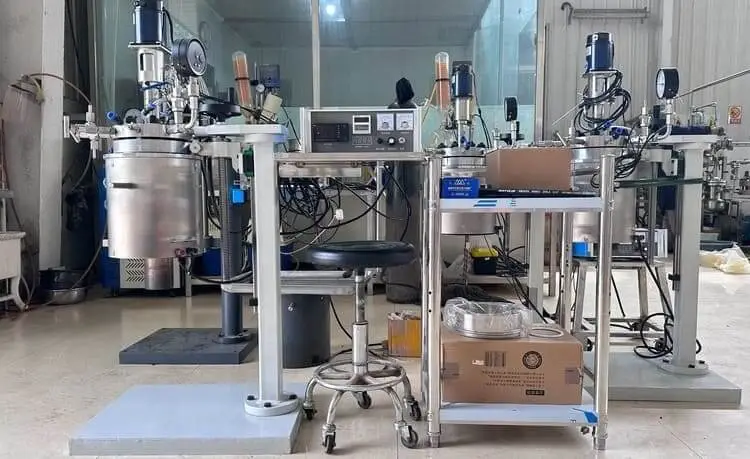
The system shown above is a real delivery: multiple modular extraction units prepared for a customer’s laboratory and pilot process-testing program.
Each unit is built around the proven CBEW-series extraction vessel and configured to the customer’s process window, utilities, and testing plan.
A standard configuration includes:
- Extraction vessel — 10 L nominal volume (other volumes on request), operating envelope up to 370 °C and 25 MPa, with a metallic-gasket bolted closure and two-thirds maximum charge rule for safe vapor space.
- All process-contact parts in SS316L — vessel body, lid and wetted closure surfaces, internal fittings, and process-contact piping. Selected specifically because near-critical water is highly oxidizing and corrosive; material certificates and as-built parts lists are verified and documented with every delivery.
- Seal-less magnetic-drive agitation — a magnetic annular coupling transmits torque to the internal stirrer with no rotating shaft seal, minimizing leakage risk under pressure. Variable-frequency speed. control from zero up to the verified operational limit
- PID-controlled electric heating — three independently switched heater groups, energized sequentially, with heating ramp controlled to ≤120 °C/h to protect the vessel from thermal stress.
- Integrated cooling — internal cooling coil plus dedicated seal-jacket cooling-water circuit for safe operation above 100 °C.
- Full instrumentation and safety architecture — pressure gauge, temperature sensing with high-temperature alarm (368 °C HIAL), factory-set metallic bursting disc, gas-phase and liquid-phase/dip-tube valving, feed and discharge connections.
- Ergonomic handling — electric lid-lifting mechanism and handwheel tilting discharge for safe opening, emptying, and cleaning between runs.
- Control cabinet — 415 V / 50 Hz three-phase supply (configured to your site standard), with heater, motor, and instrument controls in one panel.
Built for Process Verification — Not Just Operation
What distinguishes this delivery from a catalogue reactor is that the system arrives as a verification-ready platform, not just hardware.
Every delivery includes:
1. A complete, controlled SOP. Commissioning personnel and operators receive a consolidated Standard Operating Procedure covering installation, receipt inspection, nitrogen pressure-integrity testing, electrical and control verification, staged trial runs, normal operation, shutdown, cleaning, maintenance, troubleshooting, and acceptance records.
2. A staged commissioning sequence. Structured trials move from electrical/control checks (Trial A), to no-load mechanical verification (Trial B), cold-water leak and agitation runs (Trial C), hot-water functional runs with defined acceptance bands (Trial D), instrument-loop and alarm simulation (Trial E), and only then the first process run (Trial F) — each gated by formal hold points with documented sign-off.
3. Conservative, documented operating limits. Where specification sources conflict, the delivered documentation resolves every parameter conservatively and records the basis — so your QA, EHS, and engineering reviewers can trace every limit back to its source.
4. Corrosion and water-chemistry governance. Because your process may involve oxidizing conditions, botanical chemistries, or chloride-containing feedstocks, the SOP mandates a documented water-chemistry and material-compatibility review before each new process — protecting both your product and your pressure boundary.
Applications Our Customers Are Testing
Lab and pilot teams are using these modular units across a growing application space:
- Plant and specialty oils — seed, kernel, and algal oil extraction
- Essential oils and pigments — solvent-free recovery of aroma and color compounds
- Herbal and botanical constituents — polyphenols, polysaccharides, and active ingredients
- Fungal and microbial oils — single-cell oil process development
- Enzymatic hydrolysis and degradation studies — biomass fractionation and reaction kinetics
- Scale-down verification — generating pilot data to de-risk commercial SWE investment
Why Modular?
Process development rarely follows a straight line.
A modular architecture lets your team start with a single vessel and control panel, then add parallel units for comparative trials, reconfigure valving for continuous sampling, or scale vessel volume — without replacing the core platform.
Each module shares the same documentation structure and operating philosophy, so operator training and SOPs transfer directly as your program grows.
What Partnership Looks Like
We support customers well beyond delivery:
- Pre-sale engineering — process-window definition, materials and corrosion review, utility and layout planning
- Customization — vessel volume, agitation range, heating power, instrumentation, and documentation configured to your testing protocol
- Commissioning support — guided execution of the full trial-run sequence with acceptance records
- Ongoing verification — maintenance schedules, calibration planning, spare-parts packages, and process-review support as your application portfolio expands
Start Your Process Verification Program
Whether you are validating subcritical water extraction for a specific feedstock, generating scale-up data for investors, or building an internal green-chemistry capability, the fastest path is a system that arrives documented, verified, and ready for structured trial runs — not a pressure vessel you have to figure out yourself.
Contact our sales team to discuss your application, target process window, and pilot-testing plan.
We will respond with a configuration proposal, delivery timeline, and commissioning plan tailored to your laboratory.
Technical specifications referenced in this article are drawn from the delivered system’s controlled documentation.
Final configuration is confirmed per project through engineering review.
