
1. Introduction: The Quest for the Perfect Drop
To the average consumer, an Omega-3 capsule is a simple commodity.
To an industrial biotechnologist, however, that golden drop represents a hard-won victory over molecular physics.
Having analyzed the industrial landscape from the processing hubs of China to the bustling ports of Callao.
I’ve observed that the real innovation in nutritional science isn’t just the steel of the reactors—it’s the logic governing the flow.
What the market often misses in the race for purity is the sheer technical difficulty of moving from crude 18/12 fish oil to a 97% pharmaceutical-grade fraction.
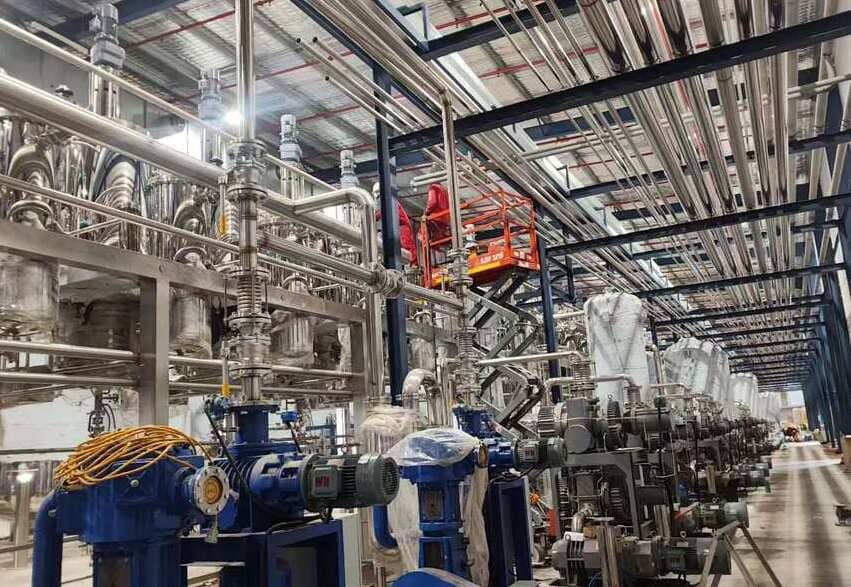
This evolution is currently being defined by a deep collaboration between conventional fish oil production lines and Chinese process engineering experts.
By utilizing the high-efficiency units of molecular short path distillation and chromatography, we can see how global expertise is redefining the standard for what we put into our bodies.
2. The “Invisible” Critical Step: Why Winterization is Non-Negotiable
In process engineering, the most impactful stage is frequently the one that happens before the “main event.”
Before the oil ever touches a molecular distiller, it must undergo “Winterization” (de-waxing).
This involves removing saturated fats like C22:0, alongside glycerides and sterols with high melting points.
From an expert perspective, the placement of this step is a masterclass in nuance: for Ethyl Ester (EE) production, winterization is typically a pre-treatment, whereas for re-esterified triglyceride (rTG) concentrates, the timing must shift to maintain molecular integrity.
Neglecting this leads to immediate fouling and clogging of the distillers, turning a multi-million dollar asset into a dormant heap of stainless steel.
Contact US for a precise solution of complete process solution, whilst the fish oil specialist strongly emphasized the necessity of proper pre-treatment before the concentration distillation stages.
Reflecting on this, we see a fundamental truth of biotechnology: the quality of the final product is a direct function of the discipline applied to the feedstock.
By addressing “the work before the work,” our experienced engineers ensure the system remains protected, yielding a feedstock pure enough for the high-intensity stages to follow.
3. From Batch to Continuous: The 8-Stage Efficiency Leap
The industry is rapidly abandoning the inefficient era of batch processing.
Traditional single-stage distillers required oil to be re-processed multiple times, a cycle that wasted energy and risked thermal degradation.
The modern frontier utilizes continuous multi-stage Short-Path Molecular Distillation (SPMD).
Modern lines now leverage 6 to 8 (and increasingly 10) continuous stages to separate fractions progressively under extreme vacuum.
This allows for “co-production”—the simultaneous extraction of different ratios, such as 36/24 EE and 30/20 EE, from the same run.
Analysis: This shift is the mandatory foundation for modern sector economics.
In a market where raw material costs are volatile, the ability to “hedge” production by drawing multiple high-value products from a single stream of Peruvian anchovy oil is what separates profitable ventures from those struggling with narrow margins.
4. The 75% Ceiling and the Tech that Breaks It
There is a distinct technological glass ceiling in the Omega-3 world: 75%.
Through advanced multi-stage distillation alone, a processor can achieve a combined EPA+DHA concentration of roughly 75%.
However, “API Pharma Grade” requires us to hunt for those final, elusive percentage points.
To reach 90% or the “holy grail” of 97%+ purity, the engineering must transition from thermal separation to more sophisticated molecular sorting:
- Urea Complexation (Inclusion): Used to reach the 85-90% range by “trapping” unwanted molecules in a crystalline lattice.
- High-Pressure Chromatography: The elite standard for 97% EPA single-fraction targets.
Reflecting on this leap, one must appreciate the diminishing returns of purity.
Reaching 97% isn’t just 22% harder than reaching 75%; it requires an exponential increase in energy and a transition to high-performance liquid chromatography systems that operate with the precision of a laboratory instrument at an industrial scale.
5. Sustainability in the Shadows: Biodiesel from Byproducts
High-end health supplements and industrial fuels often share the same origin story.
In the pursuit of 97% purity, a significant volume of “light fractions” is generated, typically containing only 2% to 4% EPA+DHA.
The surprising “circularity” of this process is found in the high-low contrast of the value chain.
While the premium molecules are destined for cardiovascular prescriptions, these light fractions are repurposed as biodiesel or pesticide adjuvants.
This ensures that the Peruvian anchovy—a critical global resource—is utilized in its entirety.
It is a striking irony of modern biotechnology that the same raw material powering a precision medicine facility also powers the tractors in a Peruvian field.
6. Engineering for Systematic Integrity and Reliability
True technology transfer is never “plug and play.”
When Chinese engineering meets overseas earthquake geography, the equipment must undergo a fundamental redesigning.
For plants located on the sea coast, the steel must be designed for “Seismic zone: N° 3,” capable of withstanding a maximum acceleration factor of 0.4g.
Beyond geology, the “management logic of the pipes and vessels”—the core architectural skeleton—must be localized.
Local height limits and multi-level layout requirements mean that a design successful in China cannot simply be dropped into user’s plant.
Analysis: This underscores why “turnkey” is a misnomer in heavy industry.
The engineering logic must be flexible enough to respect local soil, local laws, and local seismic risks while maintaining the rigorous vacuum integrity required for molecular separation.
7. Conclusion: A New Standard of Purity
The synthesis of Chinese mature process engineering and high-quality raw materials is establishing a new industry benchmark.
We are entering an era where peroxide values below 1 meq are guaranteed through total vacuum protection and nitrogen blanketing—measures that prevent even a single breath of air from oxidizing the volatile long-chain fatty acids.
As we push the boundaries of molecular purity to 97% and beyond, are we witnessing the final evolution of supplements into precision medicine?
Resource Reference:
